Good Quality White Willow Bark Extract Manufacturer in Bandung
Good Quality White Willow Bark Extract Manufacturer in Bandung Detail:
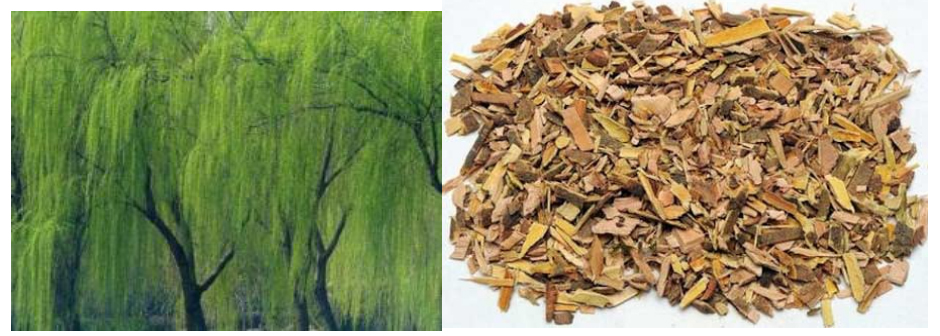
[Latin Name] Salix alba L.
[Plant Source] from China
[Specifications] Salicin 15-98%
[Appearance] Yellow Brown to White powder
Plant Part Used: Bark
[Particle size] 80 Mesh
[Loss on drying] ≤5.0%
[Heavy Metal] ≤10PPM
[Storage] Store in cool & dry area, keep away from the direct light and heat.
[Shelf life] 24 Months
[Package] Packed in paper-drums and two plastic-bags inside.
[Net weight] 25kgs/drum
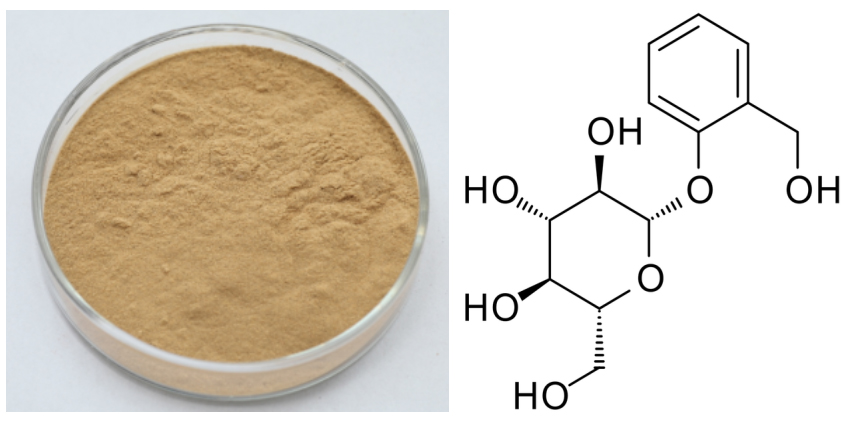
Brief Introduction
Salicin is a naturally occurring compound found in the bark of several species of trees, primarily North American in origin, that are from the willow, poplar, and aspen families. White willow, from whose Latin name, Salix alba, the term salicin is derived, is the most well known source of this compound, but it is found in a number of other trees, shrubs, and herbaceous plants as well being synthesized commercially. It is a member of the glucoside family of chemicals and is used as an analgesic and antipyretic. Salicin is used as a precursor for the synthesis of salicylic acid and acetylsalicylic acid, commonly known as aspirin.
A colorless, crystalline solid in its pure form, salicin has the chemical formula C13H18O7. Part of its chemical structure is equivalent to the sugar glucose, meaning it is classified as a glucoside. It is soluble, but not strongly so, in water and alcolhol. Salicin has a bitter taste and is a natural analgesic and antipyretic, or fever reducer. In large quantities, it can be toxic, and overdoses may lead to liver and kidney damage. In its raw form, it may be mildly irritating to skin, respiratory organs, and eyes.
Function
1. Salicin is used to ease pain and reduce inflammation.
2. Relieve acute and chronic pain, including headache, back and neck pain, muscle aches, and menstrual cramps; Control arthritis discomforts.
3. Relieve acute and chronic pain.
4. It has the same effect on the body as aspirin without any of the side effects.
5. It is an anti-inflammatory, a fever reducer, an analgesic, an anti-rheumatic, and an astringent. Specifically, it helps to relieve headaches.
Application
1.Anti-inflammatory, anti-rheumatic,
2.Reduce a fever,
3.Use as an analgesic and astringent,
4.Relieve headache,
5.Ease pain caused by rheumatism, arthritis, and carpal tunnel syndrome.
Product detail pictures:
Related Product Guide:
We have been also concentrating on enhancing the things management and QC method so that we could preserve terrific edge inside the fiercely-competitive enterprise for Good Quality White Willow Bark Extract Manufacturer in Bandung , The product will supply to all over the world, such as: Denver, Armenia, Los Angeles, If you need any of our products, or have other items to be produced, please send us your inquiries, samples or detailed drawings. Meanwhile, aiming to develop into an international enterprise group, we look forward to receiving offers for joint ventures and other cooperative projects.
https://davesmith.ludaxx.com
https://www.davegsmith.com/
https://bluelineproducts.com/
Why it Functions for over the counter appetite suppressant in this area El Paso
When it Functions for
F21 is an All Natural Sugar Blocker that assists restrict your blood sugar absorption. It consists of various substances found to have numerous wellness advantages, such as L-Arabinose, Coriolus Versicolor Polysacchride, Konjac-Mannan, Magnesium Stearate, Mint flavor: Menthol and Natural Colors. F21 not just does it help advertise weight management, (PSK) boosts your immune system feedback. In fact, for every gram of F21, you can obstruct up to 20 grams of sugar (sucrose). The formula not just assists advertise weight management, it rewards the digestion system by enabling the blocked sucrose to support helpful probiotic germs while the polysaccharide (PSK) boosts your immune system feedback.
DG Smith https://www.davegsmith.com/
over the counter appetite suppressant :
00:00:05 loose weight
00:00:11 controlling hunger
00:00:17 over the counter diet pills
00:00:23 controlling hunger
00:00:29 how to control sugar diabetes
 By Raymond from Nicaragua - 2017.01.11 17:15
Although we are a small company, we are also respected. Reliable quality, sincere service and good credit, we are honored to be able to work with you!
By Andy from Seychelles - 2018.05.13 17:00