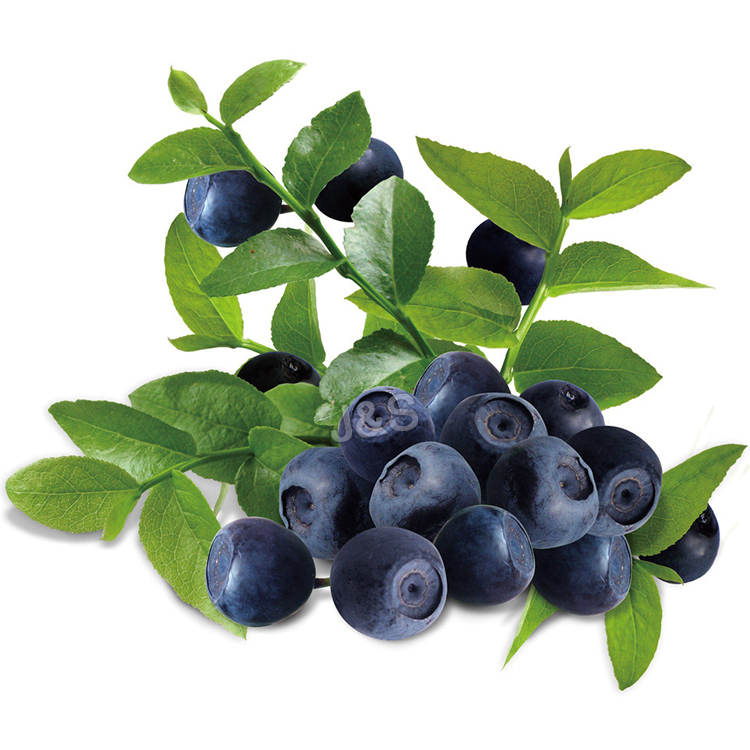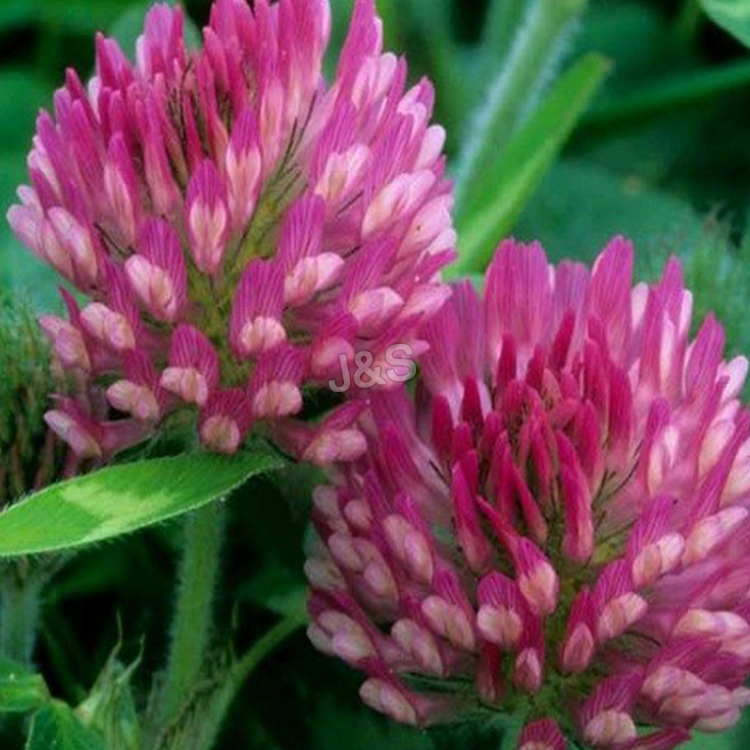
Goods high definition for Red clover extract in Dominican Republic
Goods high definition for Red clover extract in Dominican Republic Detail:
[Latin Name] Trifolium pratensis L.
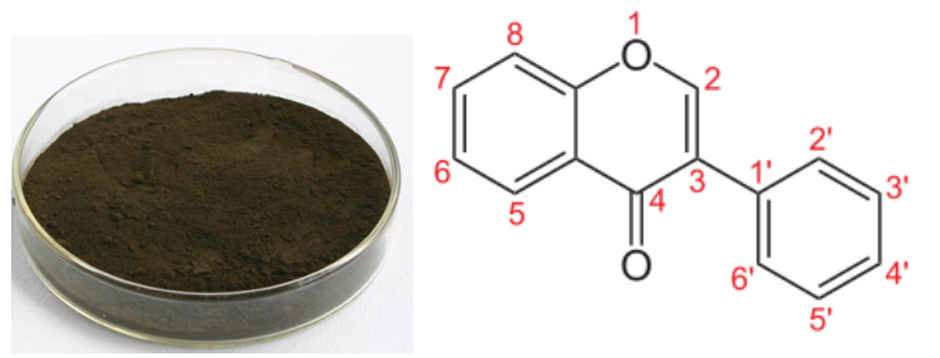
[Specification] Total isoflavones 20%; 40%; 60% HPLC
[Appearance] Brown to tan fine powder
Plant Part Used: Whole herb
[Particle size] 80Mesh
[Loss on drying] ≤5.0%
[Heavy Metal] ≤10PPM
[Storage] Store in cool & dry area, keep away from the direct light and heat.
[Shelf life] 24 Months
[Package] Packed in paper-drums and two plastic-bags inside.
[Net weight] 25kgs/drum
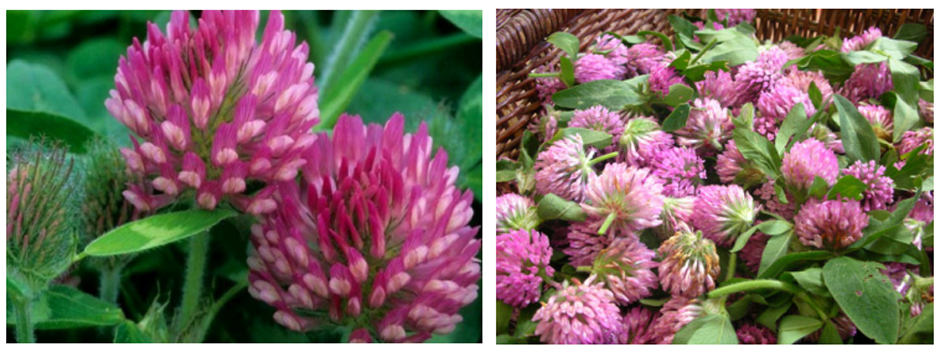
[What is Red Clober]
Red clover is a member of the legume family – the same class of plants where we find chickpeas and soybeans. Red clover extracts are used as dietary supplements for their high content of isoflavone compounds – which possess weak estrogenic activity and have been associated with a variety of health benefits during menopause (reduction of hot flashes, promotion of heart health and maintenance of bone density).
[Function]
1. Red Clover Extract can Improving health, anti-spasm, known for healing properties.
2. Red Clover Extract can Treating the skin diseases (such as eczema, burns, ulcers, psoriasis),
3. Red Clover Extract can Treating respiratory discomfort (such as asthma, bronchitis, intermittent cough)
4. Red Clover Extract can Owning anti-cancer activity and prevention of prostate disease.
5. Red Clover Extract can Most valuable of its estrogen-like effect and alleviate breast pain suffering.
6. Red Clover Extract can Contained red clover isoflavones plays in a weak estrogen, estrogen reduces the number and thusalleviate the suffering.
7. Red Clover Extract can Maintaining bone mineral density in postmenopausal women
8. Red Clover Extract can Raising high density lipoprotein cholesterol.
Product detail pictures:
Related Product Guide:
The organization keeps for the procedure concept "scientific administration, superior quality and effectiveness primacy, shopper supreme for Goods high definition for Red clover extract in Dominican Republic , The product will supply to all over the world, such as: New Zealand, Amman, Ecuador, Our qualified engineering team will usually be prepared to serve you for consultation and feedback. We are able to also deliver you with absolutely free samples to meet your needs. Best efforts might be made to offer you the ideal service and products. For anyone who is interested in our company and items, please make contact with us by sending us emails or contact us right away. In order to know our solutions and organization. ar more, you can come to our factory to determine it. We are going to usually welcome guests from around the globe to our corporation. o create small business relations with us. Please really feel no cost to speak to us for enterprise. nd we believe we are going to share the most effective trading practical experience with all our merchants.
How to Juice Wheatgrass
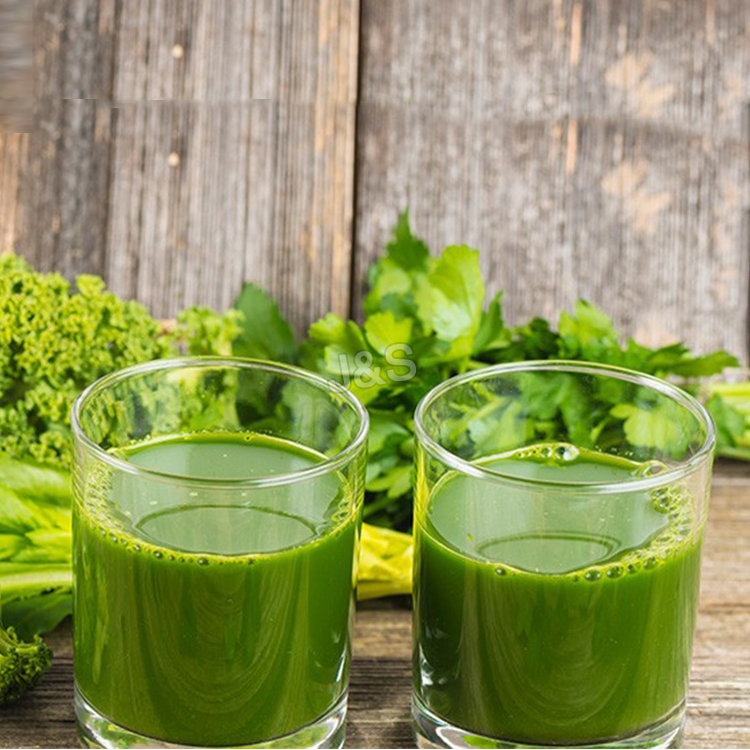
Many people believe that wheatgrass can help improve digestion, detoxify the body, clean the liver, purify the blood, and boost the production of hemoglobin. Many health food stores carry pre-made wheatgrass juice, but you can also make your own without much difficulty — or without shelling out too much money. Grinding the wheatgrass into juice using a mortar and pestle produces the most nutritious results. You can also use a blender to make wheatgrass juice, but be aware that some of the chlorophyll may oxidize due to the rapid movement of the blades, making the drink slightly less beneficial.
Harvest wheatgrass by snipping the blades about one 1/2-in. (1 1/4-cm.) above the ground. Use a clean knife or pair of scissors. The blades should be about 8 inches (20 1/3 cm.) tall, having grown for about a week after the wheat grains were sown.
Wash the blades under clean, running water. Place the wheatgrass blades inside a strainer and run cool to lukewarm tap water over the grass and through the strainer to remove any dirt, insects, or bacteria.
Chop the wheatgrass using a sharp knife. Place the wheatgrass on a cutting board and give the blades a rough chop. The smaller the pieces are, the easier it will be to grind or blend them and create the juice.
Collect enough chopped wheatgrass to fill at least 1/2 cup (113 grams). You can work in smaller or larger batches, if desired, but this amount should be enough for about two servings. This will be enough to give you a healthy dose of all of the wonderful properties that wheatgrass has in store for you.
Blend the wheatgrass and water together using the highest speed. Blending for about 60 seconds should suffice. You should be left with an emerald green juice with chunks of pulp floating at the surface.
Note that the grass may get tangled around the blades of the blender if the blades of grass are too long. This will not be an issue in most cases, and you can simply clean the blades of your blender after you finish getting the juice out. Pay attention to possible signs of trouble, though, like a slowing blade or the sounds of a struggling motor. If you suspect that the wheatgrass is clogging your blender, you may need to fish out the wayward wheatgrass before you continue blending.
Pour the juice from the blender into a glass and enjoy. You should be all done juicing your wheatgrass. Though a juicer for wheatgrass or a juicer in general can get a bit pricy, if you’re really committed to juicing wheatgrass regularly, it can make a real difference in your life. After you pour it into a glass and enjoy a portion of delicious wheatgrass juice, all you have to do is clean up your juicer and you’re all done.
Tips
You can also strain wheatgrass juice out of a blender by slipping over a cut piece of clean nylon stocking over the mouth of the blender. Secure the stocking in place, tip the blender upside down, and gently squeeze the juice and pulp into a cup.
There are special juicers available for purchase that are designed to juice wheatgrass. Both manual and electric versions are available. If you plan on drinking a lot of wheatgrass juice, it may be worthwhile to invest in one of these wheatgrass juicers. Simply follow the instructions the juicer comes with to prepare your juice.
Foodie brings you the latest information in diet, nutrition and healthy lifestyle. Whether its recipes, tips for weight loss, or spotlight on heart healthy foods, Foodie shows you that eating healthy and well doesn’t have to be boring!
Subscribe: https://www.youtube.com/user/mfoodie?sub_confirmation=1
Like us! https://www.facebook.com/mdhil
Tweet us! https://www.twitter.com/mdhil
Griffith experiment animation – lecture explains about the DNA transformation experiment by Griffith. https://shomusbiology.com/
Download the study materials here-
https://shomusbiology.com/bio-materials.html
Remember Shomu’s Biology is created to spread the knowledge of life science and biology by sharing all this free biology lectures video and animation presented by Suman Bhattacharjee in YouTube. All these tutorials are brought to you for free. Please subscribe to our channel so that we can grow together. You can check for any of the following services from Shomu’s Biology-
Buy Shomu’s Biology lecture DVD set- www.shomusbiology.com/dvd-store
Shomu’s Biology assignment services – www.shomusbiology.com/assignment -help
Join Online coaching for CSIR NET exam – www.shomusbiology.com/net-coaching
We are social. Find us on different sites here-
Our Website – www.shomusbiology.com
Facebook page- https://www.facebook.com/ShomusBiology/
Twitter – https://twitter.com/shomusbiology
SlideShare- www.slideshare.net/shomusbiology
Google plus- https://plus.google.com/113648584982732129198
LinkedIn – https://www.linkedin.com/in/suman-bhattacharjee-2a051661
Youtube- https://www.youtube.com/user/TheFunsuman
Thank you for watching
Griffith’s experiment, reported in 1928 by Frederick Griffith,[1] was one of the first experiments suggesting that bacteria are capable of transferring genetic information through a process known as transformation.[2][3]
Griffith used two strains of pneumococcus (Streptococcus pneumoniae) bacteria which infect mice — a type III-S (smooth) and type II-R (rough) strain. The III-S strain covers itself with a polysaccharide capsule that protects it from the host’s immune system, resulting in the death of the host, while the II-R strain doesn’t have that protective capsule and is defeated by the host’s immune system. A German bacteriologist, Fred Neufeld, had discovered the three pneumococcal types (Types I, II, and III) and discovered the Quellung reaction to identify them in vitro.[4] Until Griffith’s experiment, bacteriologists believed that the types were fixed and unchangeable, from one generation to another.
In this experiment, bacteria from the III-S strain were killed by heat, and their remains were added to II-R strain bacteria. While neither alone harmed the mice, the combination was able to kill its host. Griffith was also able to isolate both live II-R and live III-S strains of pneumococcus from the blood of these dead mice. Griffith concluded that the type II-R had been “transformed” into the lethal III-S strain by a “transforming principle” that was somehow part of the dead III-S strain bacteria.
Today, we know that the “transforming principle” Griffith observed was the DNA of the III-S strain bacteria. While the bacteria had been killed, the DNA had survived the heating process and was taken up by the II-R strain bacteria. The III-S strain DNA contains the genes that form the protective polysaccharide capsule. Equipped with this gene, the former II-R strain bacteria were now protected from the host’s immune system and could kill the host. The exact nature of the transforming principle (DNA) was verified in the experiments done by Avery, McLeod and McCarty and by Hershey and Chase. Source of the article published in description is Wikipedia. I am sharing their material. Copyright by original content developers of Wikipedia.
Link- https://en.wikipedia.org/wiki/Main_Page
 By Marian from Paraguay - 2017.02.18 15:54
We are really happy to find such a manufacturer that ensuring product quality at the same time the price is very cheap.
By Kristin from Belize - 2018.03.03 13:09