Low MOQ for Sodium copper chlorophyllin Wholesale to Estonia
Low MOQ for Sodium copper chlorophyllin Wholesale to Estonia Detail:
[Specification] 99%
[Appearance] Dark Green powder
Plant Part Used:
[Particle size] 80Mesh
[Loss on drying] ≤5.0%
[Heavy Metal] ≤10PPM
[Storage] Store in cool & dry area, keep away from the direct light and heat.
[Shelf life] 24 Months
[Package] Packed in paper-drums and two plastic-bags inside.
[Net weight] 25kgs/drum
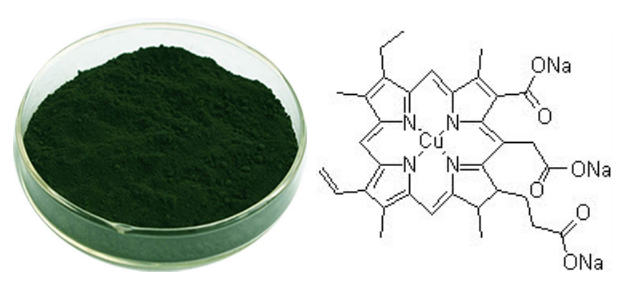
[What is that?]
Chlorophyll is a natural green pigment which is obtained through extraction and refining processes from natural green plants or silkworm feces.Chlorophyll is stabilized chlorophyll, which is prepared from chlorophyll by saponification and replacement of magnesium atom with copper and sodium. Chlorophyll is dark green to blue black powder, easily soluble in water but slightly soluble in alcohol and chloroform, with transparent jade green water solution without sediment.
[Function]
1.clears up odors of putrefaction effectively.
2.play an important role on cancer prevention.
3.Chlorophyll has superior coloring strength and good stabilization in neutral and alkali solutions.
4.Chlorophyll has effect on liver protection, fastening healing of stomach ulcers and intestine ulcers.
5.The active ingredient in a number of internally-taken preparations intended to reduce odors associated with incontinence, colostomies and similar procedures, as well as body odor in general.
6.Chlorophyll has strong antibacterial action, which makes it useful in surgeries, ulcerative carcinoma, acute rhinitis and rhinosinusitis, chronic ear infections, inflammations, etc.
Product detail pictures:
Related Product Guide:
Our eternal pursuits are the attitude of "regard the market, regard the custom, regard the science" plus the theory of "quality the basic, have faith in the main and management the advanced" for Low MOQ for Sodium copper chlorophyllin Wholesale to Estonia , The product will supply to all over the world, such as: India, Turkey, Kazakhstan, Qualified R&D engineer might be there for your consultation service and we will try our best to meet your requirements. So you should feel free to contact us for inquiries. You'll be able to send us emails or call us for small business. Also you are able to come to our business by yourself to get further knowing of us. And we are going to surely present you with the best quotation and after-sale service. We're ready to build stable and friendly relations with our merchants. To achieve mutual success, we'll make our best efforts to build a solid co-operation and transparent communication work with our companions. Above all, we're here to welcome your inquiries for any of our merchandise and service.
This video shows you how to pronounce Antiplastic
https://www.ibiology.org/ibioseminars/jared-leadbetter-part-1.html
Talk Overview:
Leadbetter begins his seminar by comparing the biological diversity in the gut of the termite to the diversity found in the Sargasso Sea. The hindgut of the dampwood termite Zootermopsis nevadensis has one of the highest densities of microbes found on earth and includes bacteria, archaea and eukaryotes of all shapes and sizes. Protozoa in the termite gut breakdown the polysaccharides in wood to produce acetate; a food source for the termite. The breakdown of wood also produces H2 and CO2. Archaea in the gut convert the H2 and CO2 to methane, while bacteria compete to convert the H2 and CO2 to more acetate thus reducing methane production. Leadbetter and his colleagues were the first to identify and successfully culture acetogenic spirochetes from the termite gut. They have since found gut bacteria capable of fixing atmospheric nitrogen and producing protein. Using genetics, Leadbetter is now studying the diversity and evolution of termites and their gut bacteria.
Speaker Biography:
Jared Leadbetter was an undergraduate biology student at Goucher College when he attended a summer course on microbial diversity at the Marine Biological Laboratory in Woods Hole, Massachusetts. It was here that he first became fascinated with the amazing environment of the termite gut. Leadbetter went on to study termite gut microbes for his PhD at Michigan State University and as a post-doc at the University of Iowa.
Currently, Leadbetter is a professor of Environmental Microbiology and Environmental Science and Engineering at the California Institute of Technology. He is also co-director, with Dianne Newman, of the Marine Biological Lab’s summer course on Microbial Diversity. Using physiological, chemical and molecular genetics techniques, Leadbetter’s lab strives to understand the symbiotic relationship between termites and their diverse gut microbes. A better understanding of how termite gut microbes limit methane production and how they break down material such as lignin and cellulose may help reduce methane production by cows and improve the production of biofuels.
 By Ruth from Senegal - 2018.07.27 12:26
The company account manager has a wealth of industry knowledge and experience, he could provide appropriate program according our needs and speak English fluently.
By Margaret from Lithuania - 2018.06.28 19:27