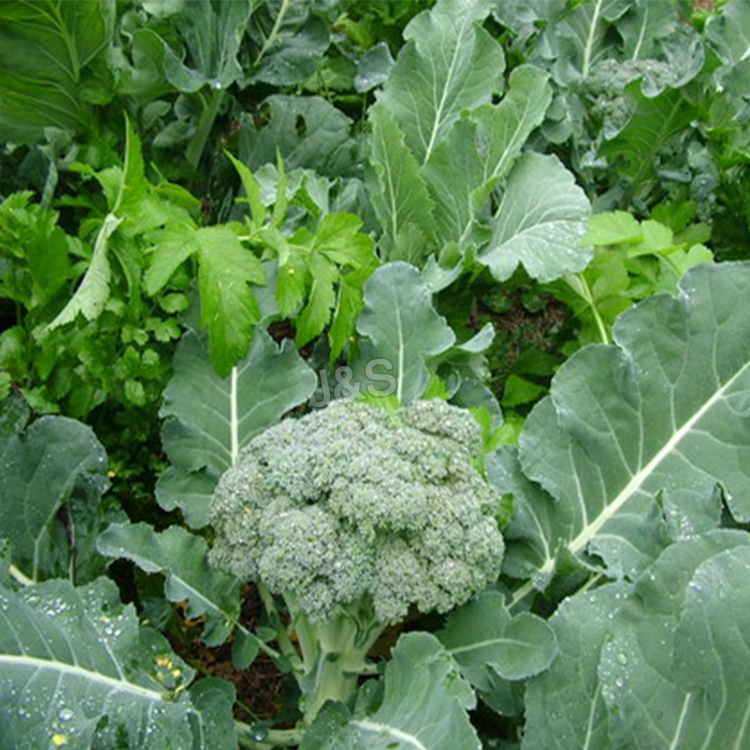
Lowest Price for Broccoli powder in Cambodia
Lowest Price for Broccoli powder in Cambodia Detail:
[Latin Name] Brassica oleracea L.var.italica L.
[Plant Source] from China
[Specifications]10:1
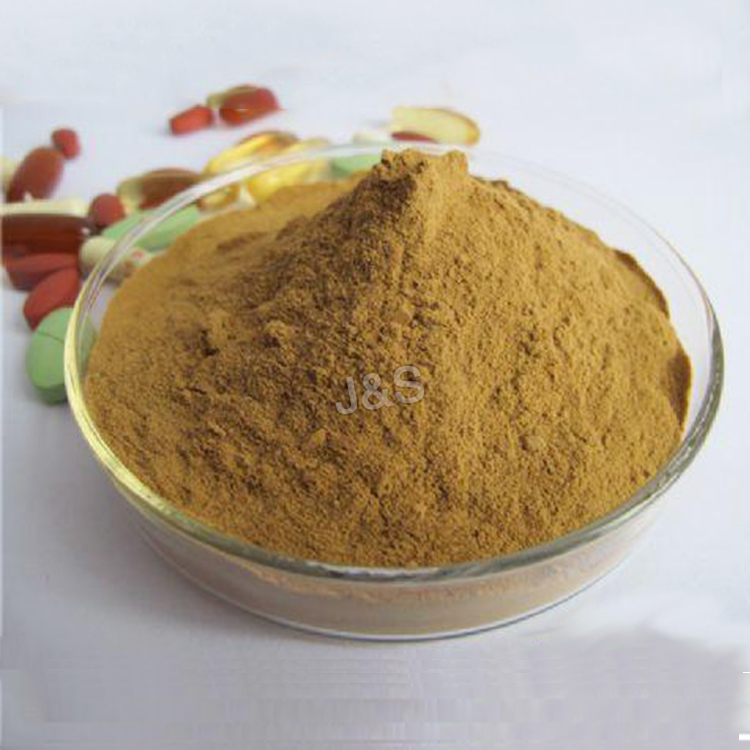
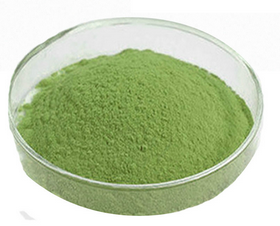
[Appearance] Light green to green powder
Plant Part Used: whole plant
[Particle size] 60 Mesh
[Loss on drying] ≤8.0%
[Heavy Metal] ≤10PPM
[Storage] Store in cool & dry area, keep away from the direct light and heat.
[Shelf life] 24 Months
[Package] Packed in paper-drums and two plastic-bags inside.
[Net weight] 25kgs/drum
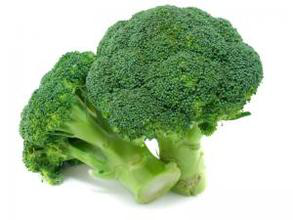
Broccoli is a member of the cabbage family, and is closely related to cauliflower. Its cultivation originated in Italy. Broccolo, its Italian name, means “cabbage sprout.” Because of its different components, broccoli provides a range of tastes and textures, from soft and flowery (the floret) to fibrous and crunchy (the stem and stalk). Broccoli contains glucosinolates, phytochemicals which break down to compounds called indoles and isothiocyanates (such as sulphoraphane). Broccoli also contains the carotenoid, lutein. Broccoli is an excellent source of the vitamins K, C, and A, as well as folate and fiber. Broccoli is a very good source of phosphorus, potassium, magnesium and the vitamins B6 and E.
Main Function
(1).With the function of anti-cancer, and effectively improving capability of blood scavenging;
(2).Having the great effect to prevent and regulate hypertension;
(3).With the function of enhancing liver detoxification, improve immunity;
(4).With the function of reducing blood sugar and cholesterol.
4. Application
(1).As drugs raw materials of anti-cancer, it is mainly used in pharmaceutical field;
(2).Applied in health product field, it can be used as raw material in health food, the purpose is to enhance immunity
(3).Applied in food fields, it is widely used as functional food additive.
Product detail pictures:
Related Product Guide:
Our concentrate on is always to consolidate and enhance the excellent and service of present solutions, in the meantime regularly develop new products to meet distinctive customers' demands for Lowest Price for Broccoli powder in Cambodia , The product will supply to all over the world, such as: Provence, Riyadh, Turkey, In order to make more people know our products and to enlarge our market, we have devoted a lot of attention to technical innovations and improvement, as well as replacement of equipment. Last but not the least, we also pay more attention to training our managerial personnel, technicians and workers in planned way.
Music by Parry Gripp
This video was created thanks to the support of the Grain Foods Foundation.
Learn more about the benefits of eating grain foods at https://grainfoodsfoundation.org/
——————-
[LYRICS]
Awwwwwwww…
Eat a sandwich, eat a sandwich
Any kind of flavor, it doesn’t matter which!
Put a big piece of bread on each side
You’re in for a de-licious ride!
Peanut butter jelly, or portobello
Open up your mouth, and say “hello!”
I’d to party but I’m feeling slow
Just eat a bite of sandwich and you’re good to go!
EAT A SANDWICH (yeah!)
EAT A SANDWICH (come on!) EAT A SANDWICH (get on a roll!) EAT A SANDWICH
Get-ee get that Sandwich Power!
EAT A SANDWICH (awww!)
EAT A SANDWICH (here we go!) EAT A SANDWICH (toast that bun!) EAT A SANDWICH
Get-ee get that Sandwich Power!
Eat a sandwich, eat a sandwich
You’re eating like a king, don’t have to be rich!
I’ve got a ham and swiss on rye
You’re living the dream! Give me a high-five!
Well I use lettuce instead of a bun
And you ain’t having fun
But gluten’s bad, I read it online
NONSENSE! Don’t waste my time
‘Cause it’s sandwich time! it’s sandwich time! It’s san-san-san-san sandwich time!
EAT A SANDWICH (uhhh!)
Music by Parry Gripp
https://parrygripp.com/
This video was created thanks to the support of the Grain Foods Foundation.
Learn more about the benefits of eating grain foods at https://grainfoodsfoundation.org/
EAT A SANDWICH (stack up that bread!) EAT A SANDWICH (gimme that sour dough!) EAT A SANDWICH
Get-ee get that Sandwich Power!
Awwww yeah, it’s M.C. Butter in the house.
It’s time for the Sandwich Roll Call (sandwich roll call…)
BLT – Sandwich power!
Ham and swiss – Sandwich power! Lobster roll – Sandwich power! Get-ee get that Sandwich Power!
Roast Beef – Sandwich power! Chicken Salad – Sandwich power! Italian Hoagie – Sandwich power! Get-ee get that Sandwich Power!
EAT A SANDWICH (uh!)
EAT A SANDWICH (yeah!)
EAT A SANDWICH (do it right now!) Get-ee get that Sandwich Power!
GET RID OF ACNE Spin Brush- https://vpwow.com/sb4spin1
70% OFF COUPON CODE: SB4SPIN1
Also comes with 1 YEAR WARRANTY
MY CLEAR SKINCARE ROUTINE- https://youtu.be/AQX8ByCz1kQ
Charcoal Peel Off Mask
BLACKHEAD PORE VACUUM- https://youtu.be/GwYyoisoMZI
LIGHTEN DARK UNDERARMS- https://youtu.be/aitg5muWeJw
Sign up with Uber and get your first ride free! Use my code: Shaniqueb81ue
How I Maintain My Hair Styles (Twistouts, Wash and Go’s etc) https://www.hergivenhair.com/protective-headband-for-natural-hair-p-28/?y=Shanique
My Vlog Channel- https://goo.gl/pSGHKS
MY BIG CHOP- https://youtu.be/BBves5kmzLA
How To Blow Dry Natural Hair- https://youtu.be/QOTM14dPEtw
Faster Hair Growth
Shampoo Massage Brush- https://vpwow.com/sb4hair1
Coupon Code- SB4HAIR1 Original Price $39.99 Get It For $19.99
Detox Tea to help reduce bloating
Teamiblends.com
Use the code waistlength to get 10% off your order
My Review- https://youtu.be/h5WbyusGbUw
All Natural Deep Conditioner Remi Hair Treatment: https://vpwow.com/remijourney
Use code REMIJOURNEY for 50% off $30, Get it for $15!
Dry Your Nail in 20secs Glow Dry LED Nail Dryer: https://vpwow.com/glowjourney
Use code GLOWJOURNEY for 70% off $100, Get it for only $30!
BEST Teeth Whitening: https://vpwow.com/smilejourney
Use code SMILEJOURNEY for 75% off $120, Get it for only $30!
——————————————————————————————————–
Business Inquiries and Hair Help
Email Me: journeytowaistlength@hotmail.com
Hair Length Check Shirts
https://buntyn.spreadshirt.com/length-check-shirt-A11133779
How I Make My Leave-in/Moisturizer
————————————————————————————————————————————–
FAQ
Hair Type- 4a,4b, 4c
Last Relaxer Aug 30th 2013
Big Chop Date: Aug 2015
Camera: Canon Rebel T3I (original lens)https://go.magik.ly/ml/oak/
and canon 50mm len – https://go.magik.ly/ml/oai/
Editing Software: Final Cur Pro
Lighting: Artificial bedroom lights (60w daylight bulbs)
————————————————————————————————————————————–
❤My Hair Regimen
❤How To Get Thicker Hair!!
❤How To Grow Hair Fast!
❤Add Me On Facebook
https://www.facebook.com/youngebz07
❤FOLLOW MY BLOG
https://journey2waistlength.blogspot.ca/
❤Instagram
Journey- @_journeytowaistlength
❤ Snapchat-
Shanique12
******************************************************************************
DISCLAIMER: ALL PRODUCTS WERE BOUGHT BY ME, UNLESS SAID IN VIDEO. ALL OPINIONS ARE 100% MY OWN.
******************************************************************************
Want to make some extra money? Join
https://grapevinelogic.com/creator/?referrer=journeyto-waistlength
 By Emma from Mauritania - 2018.11.06 10:04
Goods just received, we are very satisfied, a very good supplier, hope to make persistent efforts to do better.
By Fernando from Nigeria - 2018.06.26 19:27