Manufacturing Companies for Red clover extract in Dominica
Manufacturing Companies for Red clover extract in Dominica Detail:
[Latin Name] Trifolium pratensis L.
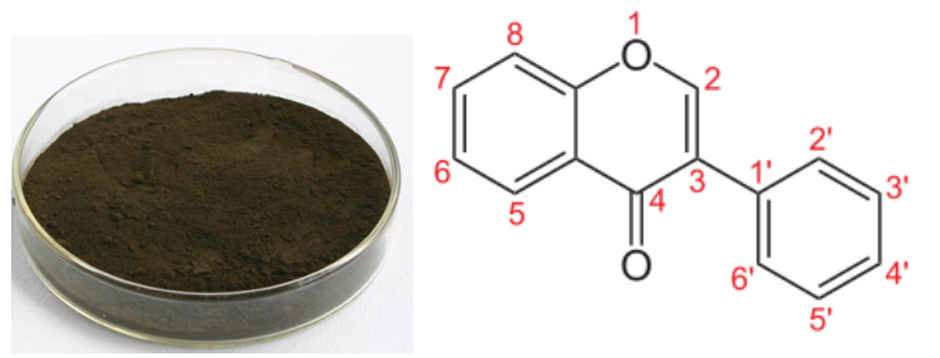
[Specification] Total isoflavones 20%; 40%; 60% HPLC
[Appearance] Brown to tan fine powder
Plant Part Used: Whole herb
[Particle size] 80Mesh
[Loss on drying] ≤5.0%
[Heavy Metal] ≤10PPM
[Storage] Store in cool & dry area, keep away from the direct light and heat.
[Shelf life] 24 Months
[Package] Packed in paper-drums and two plastic-bags inside.
[Net weight] 25kgs/drum
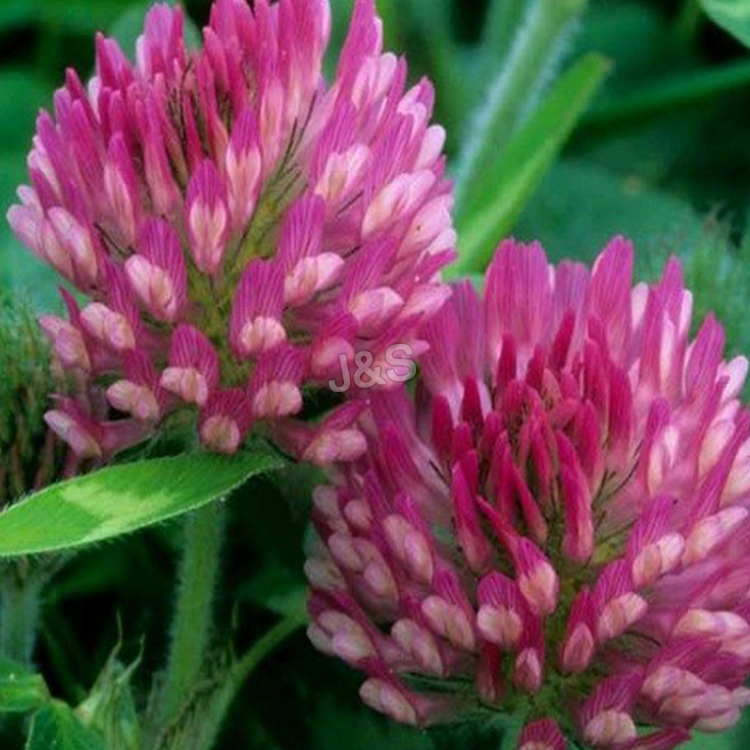
[What is Red Clober]
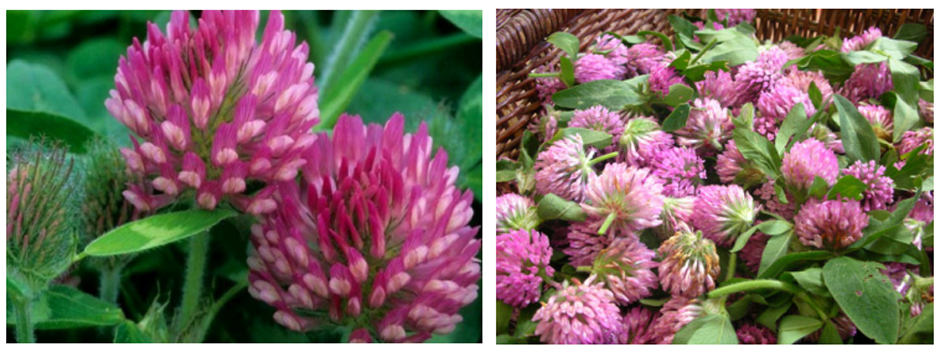
Red clover is a member of the legume family – the same class of plants where we find chickpeas and soybeans. Red clover extracts are used as dietary supplements for their high content of isoflavone compounds – which possess weak estrogenic activity and have been associated with a variety of health benefits during menopause (reduction of hot flashes, promotion of heart health and maintenance of bone density).
[Function]
1. Red Clover Extract can Improving health, anti-spasm, known for healing properties.
2. Red Clover Extract can Treating the skin diseases (such as eczema, burns, ulcers, psoriasis),
3. Red Clover Extract can Treating respiratory discomfort (such as asthma, bronchitis, intermittent cough)
4. Red Clover Extract can Owning anti-cancer activity and prevention of prostate disease.
5. Red Clover Extract can Most valuable of its estrogen-like effect and alleviate breast pain suffering.
6. Red Clover Extract can Contained red clover isoflavones plays in a weak estrogen, estrogen reduces the number and thusalleviate the suffering.
7. Red Clover Extract can Maintaining bone mineral density in postmenopausal women
8. Red Clover Extract can Raising high density lipoprotein cholesterol.
Product detail pictures:
Related Product Guide:
We can constantly satisfy our respected customers with our good high quality, good price tag and good support due to we have been additional specialist and extra hard-working and do it in cost-effective way for Manufacturing Companies for Red clover extract in Dominica , The product will supply to all over the world, such as: Nigeria, Israel, Indonesia, Business philosophy: Take the customer as the Center, take the quality as the life, integrity, responsibility, focus, innovation.We will provide professional, quality in return for the trust of customers, with most major global suppliers,all of our employees will work together and move forward together.
https://4GuideYou.Com/how-make-wine How to Make Wine at Home
You can make 5 gallons of wine at home with a few ingredients and some basic winemaking supplies. The varieties of grapes, fruits and any other additional ingredients determine the type of wine you make.
Instructions, Things You’ll Need
* Winemaking kit (most kits contain everything you need to make wine)
* Favorite wine recipe
* Produce prepared according to your recipe
* Sodium or potassium bisulfite powder
* Cheesecloth
* Yeast specifically for winemaking
* Water
Step #1: Find a good basic recipe for your first wine making experience. Use one that has been tried and proven. The wrong recipe can produce a batch of cloudy, vinegary wine.
Step #2: Prepare the produce you’ve chosen for your wine. Remove all large pits. Cut up large fruit, crack the skin on small fruit, chop small ingredients (such as raisins) and bruise all other forms of produce you’ll be using. Almost any kind of fruit can be used to make wine. Once you become familiar with the process, you may want to experiment to produce different types of wine.
Step #3: Stir together all of the winemaking ingredients except for the yeast into a primary fermenter. Collect all of the produce pulp in the fermentation bag, submerging it into the wine making mixture.
Step #4: Add water to the primary fermenter container, bringing it up to 5 gallons and then add sodium or potassium bisulfite powder or tablets according to the directions on the label. Don’t add the yeast yet. These tablets kill mold and bacteria but will also kill yeast if added too soon.
Step #5: Cover the fermenter with several layers of cheesecloth and let it rest for 24 hours. The sulfur gas produced by the bisulfite sterilizes the juice and dissipates after 24 hours. After that point it’s safe to add the yeast by sprinkling it over the juice’s surface. Cover the juice with a clean cloth and let it ferment for 5 to 7 days. If everything is working right, fermentation should begin within 24 hours.
Step #6: Remove the fermentation bag, squeeze out the excess juice and then dispose of the contents. Siphon the wine into the secondary container in such a way that you leave as much sediment behind as possible. Add water if necessary to get the fluid level back to the original 5 gallons.
Step #7: Place an air-lock device on the secondary container, fill it halfway with water and let the juice ferment for 4 to 6 weeks, until it’s completely clear. Siphon the wine again, leaving all of the sediment behind. Stir in bisulfite according to your recipe and then bottle your wine.
To lean more about How to Make Wine at Home, please visit : https://4GuideYou.Com/how-make-wine
Stevia grows best in upland areas in sub-tropical climate. In other places it can be grown as an annual. The plant prefers a lightly textured, well-drained soil to which matter has been added. It needs ample water so that the soil is consistently moist, but not wet. In hot, sunny climates it will do best in semi-shade. Propagation is from seed sown in spring, but germination rates can be low-expect half the seeds sown not to germinate. Plant seedlings out once all danger of frost is over. Leaves are best harvested just before flowering. The plants will also grow from cuttings,which are best taken in late winter.The concentration of stevioside in the leaves of Stevia increasing when the plants are grown under long day condition.While, cultivating stevia on a large scale, it can be grown in well-drained red soil and sandy loam soil. The soil should be in the pH range of 6.5-7.5. Saline soils should be avoided to cultivate this plant.
Stevia can be successfully cultivated all around the year all over India expect theareas, which receive snowfall, or temperatures go below 5 degree Celsius in winter.The summer temperatures actually do not affect this plant if the high summer temperatures have already been factored in the cultivation practices.Since seed germination rate is very poor,it is propagated vegetative. Though stem cuttings are used for vegetative tissue culture plants have proven to be the best planting material for Stevia. Tissue culture plants of Stevia are genetically pure, free from pathogens and haveexcellent vigor. The tissue culture plants can be planted throughout the year,expect during peak summer. An ideal planting density is 40,000 plants per acre with spacing of 25×40 cm in a raised bed system. The soil can be enriched with abasal dressing of 25 tons of well rotten farmyard manure/hectare
Soil Type
Stevia requires very good drainage any soil that retain the moisture for very long period of time are unsuitable for Stevia cultivation and should be religiously avoided.Red soil and sandy loam with a 6-7 pH are best for the cultivation of Stevia.
Raised bed preparation
Forming raised beds is the most economical way to grow Stevia. The raised bed should be of 15 cm in height and 60 cm in width. The distance between each plant 23 cm. This would give a plant population of around 40,000 per acre.
Planting Material
There are basically two options for multiplication. The first is the tissue culture and second the stem cutting. Tissue culture is the best option but many farmers are tempted to try the stem cutting method for multiplication. As per practical experience, stem cutting is sometimes more expensive to produce than the tissue culture since the success rate of the stem cuttings establishment is very low, it takes minimum of 25 weeks for the stem cutting to develop in proper feeding roots for transplantation (younger stem cuttings transplants have shown more than 50% mortality in first few weeks of transplants in main field).
Harvesting
Another important aspect of harvesting is the timing of harvest. It should be noted that at no point of time plants should be allowed to flower since after flowering the Stevioside percentage goes down rapidly and leaves are rendered unmarketable. Leaves are harvested by plucking in a small quantity, or the entire plant with the side branches is cut leaving 10 to 15 cm from the base.The first harvesting can be done four to five months after planting. Subsequent harvesting can be done every three months, for five consecutive years. The sweetener in the leaf is maximum till the plant flowers. Just before flowering, the plant should be cut completely leaving 10 cm from the ground. The new flush of leaves will sprout from here. The new plant will be ready for harvest again in three months. The plant yields around 3000 kg of dried leaves from an acre of plantation every year. Harvesting should be done as late as possible, since cool autumn temperatures and shorter days tend to intensify the sweetness of the plants as they evolve into a reproductive state.
Unlocking the sweetness in your harvest
Once all leaves have been harvested it’s required to dry them. This can be
accomplished on a net. The drying process is not one that requires excessive heat;more important is good air circulation. On a moderately warm fall day, stevia crop can be quick dried in the full sun in about 12 hours. (Drying times longer than that will lower the stevioside content of the final product.)
Crushing the dried leaves is the final step in releasing stevia’s sweetening power. The
dried leaves are powdered, sieved and the fine powder is stored in containers. This can be done either by hand or, for greater effect, in a coffee grinder or in a special blender for herbs.
Web: https://www.natureherbs.org | www.natureherbs.co
Email : natureherbs@ymail.com
Watsapp: +91 841 888 5555
Skype: nature.herbs
 By Miguel from Barcelona - 2018.12.05 13:53
The manufacturer gave us a big discount under the premise of ensuring the quality of products, thank you very much, we will select this company again.
By Prudence from Kuwait - 2017.11.29 11:09