Professional China Lyophilized royal jelly powder Supply to Dubai
Professional China Lyophilized royal jelly powder Supply to Dubai Detail:
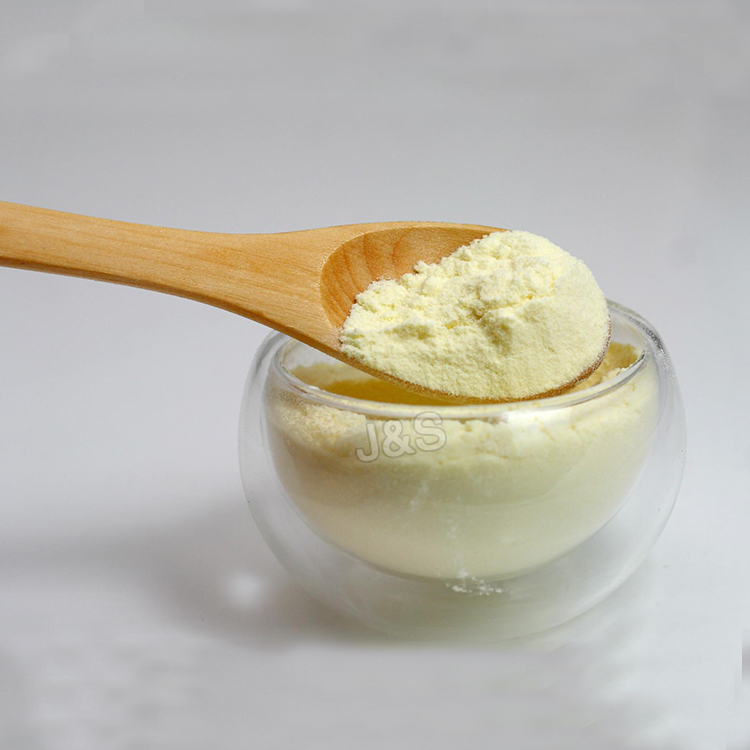
[Products Name] Royal jelly powder,Lyophilized royal jelly powder
[Specification] 10-HDA 4.0%, 5.0%, 6.0%, HPLC
[Gerneral feature]
1. Low antibiotics, Chloramphenicol< 0.1ppb
2. certified by, according to EOS & NOP standard;
3.100% pure with no additives;
4. More easily absorbed into the body than fresh royal jelly
5. Can be easily produced into tablets.
[Our advantages]
- 600 bee farmers, 150 units of bee-feeding groups located in natural mountains;
- certificated by;
- NON-antibiotics, widely exported to Europe;
- Health Certificate, Sanitary Certificate and Quality Certificate are available.
[Lyophilized technology]
Lyophilized technology, also known as Freeze-drying, it is a dehydration process typically used to maintain activity of all nutrition ingredients in royal jelly, also to make the royal jelly convenient for transport. Freeze-drying works by freezing the material and then reducing the surrounding pressure to allow the frozen water in the material to sublimate directly from the solid phase to the gas phase. This technology can maintain all activity of nutrition ingredient.
Lyophilized royal jelly powder is processed directly from fresh royal jelly.
3kgs fresh royal jelly is used to make 1kg lyophilized royal jelly powder.
During all the production process, there is no additives.
[Packing]
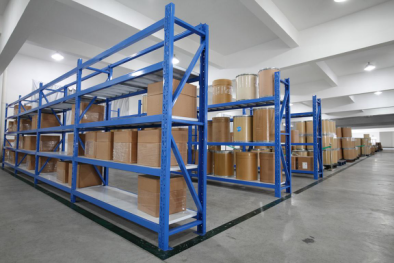
5kg/bag, 25kgs/drum
1kg/bag, 20kgs/carton
Main indices of physical and chemic in Lyophilized royal jelly
| Ingredients Indices | Lyophilized royal jelly | Standards | Results |
| Ash | 3.2 | <5 | Complies |
| Water | 4.1% | <7% | Complies |
| Glucose | 43.9% | <50% | Complies |
| Protein | 38.29% | >33% | Complies |
| 10-HDA | 6.19% | >4.2% | Complies |
[Our work flow]
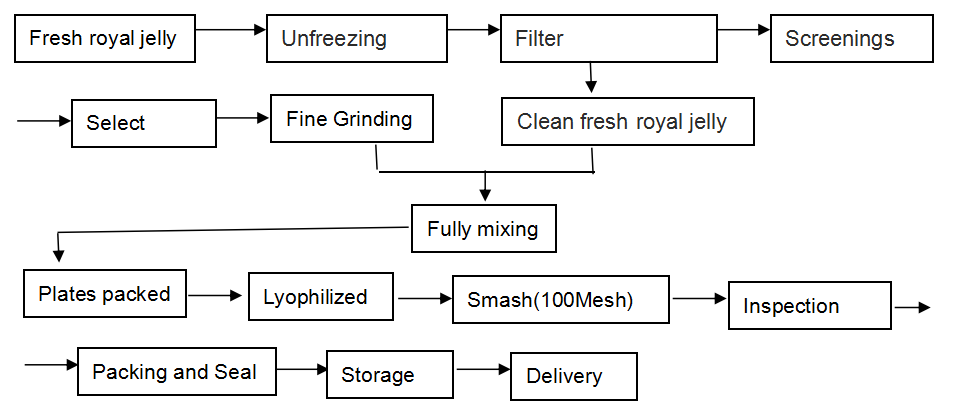
Our Lyophilized Royal Jelly Powder is produced in this way: we lyophilize the fresh royal jelly by advanced freeze-drying facilities without losing any nutritional ingredients, reserving the natural ingredients in utmost, and then make them into the form of powder, for any food additives are not needed to add.
The raw material we use is the natural fresh royal jelly which is up to the export standard . We process our products strictly according to export standard. Our workshop is up to the requirements of GMP.
Royal Jelly powder has been selected as drug excipients by many European and American pharmaceutical producing enterprises.Meanwhile it is applies to health food and cosmetics industries.
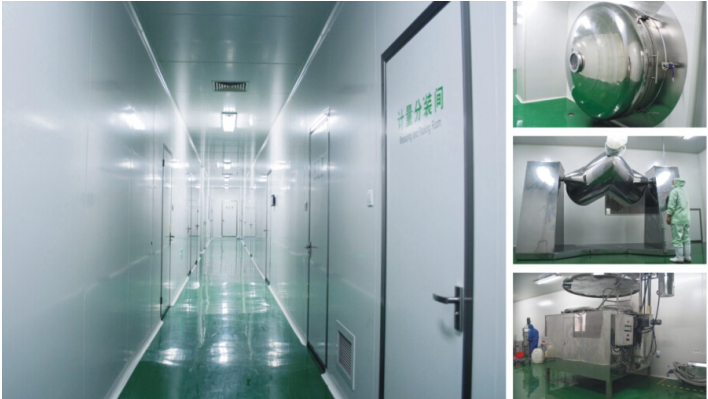
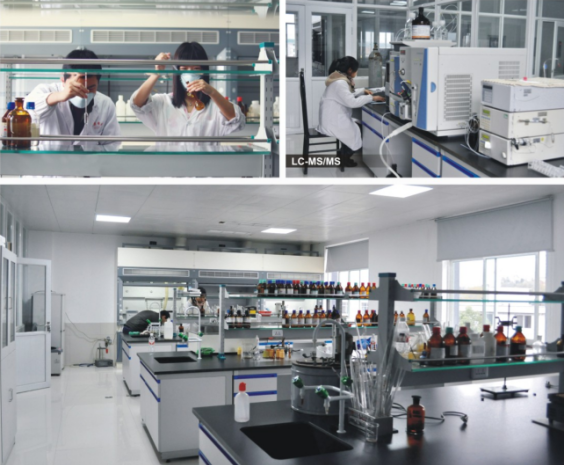
[Quality control]
Traceability record
GMP standard production
Advanced inspection equipment
[Function]
1.Enhances the immune system
2.Promotes wound healing
3.Has antitumor/anticancer properties
4.Lowers cholesterol levels
5.Increases fat metabolism
6.Is a powerful antioxidant
7.Regulates blood sugar levels
[Applications]
It’s widely used in health tonic, health pharmacy, hairdressing and cosmetic area, and mainly was applied in capsules, troche and oral liquids etc.
Product detail pictures:
Related Product Guide:
Using a complete scientific high quality management program, superior high quality and superior faith, we acquire great reputation and occupied this industry for Professional China Lyophilized royal jelly powder Supply to Dubai , The product will supply to all over the world, such as: Bangladesh, British, Madrid, Our company will adhere to "Quality first, , perfection forever, people-oriented , technology innovation"business philosophy. Hard work to keep making progress, innovation in the industry, make every effort to first-class enterprise. We try our best to build the scientific management model, to learn abundant skilled knowledge, to develop advanced production equipment and production process , to create the first-call quality solutions, reasonable price , high quality of service , quick delivery , to offer you create new value .
The power of cranberries in the past present and future
กระเพาะปัสสาวะอักเสบ (Urinary Tract Infections. UTI)
#แครนเบอรี่ #cranberry
#โปรแอนโทไซยานิดิน #proanthocyanidin
#Pacs #36mg
สอบถามข้อมูลเพิ่มเติม
Tel 0888-515-666, 02-718-0700 ถึง2
www.harnthai.com
Paul Andersen details the first 7 of 13 labs in the AP Biology Curriculum. The following topics are all covered: Artificial Selection, Hardy-Weinberg Equilibrium, Comparing DNA using BLAST, Diffusion and Osmosis, Photosynthesis, Respiration, Mitosis and Meiosis.
Intro Music Atribution
Title: I4dsong_loop_main.wav
Artist: CosmicD
Link to sound: https://www.freesound.org/people/CosmicD/sounds/72556/
Creative Commons Atribution License
All images are either Public Domain or Creative Commons Attribution Licenses: Amada44. Laboratory Glassware, [object HTMLTableCellElement]. Own work. https://commons.wikimedia.org/wiki/File:Beaker.svg.
———. Scan of a Brussel Sprout, [object HTMLTableCellElement]. Own work. https://commons.wikimedia.org/wiki/File:Brussel_sprout.png.
America, Gage Skidmore from Peoria, AZ, United States of. Hank Green Speaking at VidCon 2012 at the Anaheim Convention Center in Anaheim, California. Please Attribute to Gage Skidmore If Used Elsewhere., June 30, 2012. Hank Green Uploaded by MaybeMaybeMaybe. https://commons.wikimedia.org/wiki/File:Hank_Green_(7492551432).jpg.
Boutet, Emmanuel. English: Epiderm of a Leaf of Arabidopsis Thaliana Seen by Cryo-scanning Electron Microscopy (cryo-SEM). Remark the Stomata., 2002. Own work. https://commons.wikimedia.org/wiki/File:Arabidopsis-epiderm-stomata.jpg.
Brisbane, Photograph by Erich Schulz. English: 10ml Terumo (r) Syringe with Luer Lock Tip. Manufactured in the Philippines., 2004. en:Image:Syringe.jpg. https://commons.wikimedia.org/wiki/File:Syringe.jpg.
Dejuliot. PGLO Visualized Under Ultraviolet Light, 5/08. Own work. https://commons.wikimedia.org/wiki/File:PGlo-UltraViolet.jpg.
en.wikipedia, Original uploader was MarcoTolo at. A Plate Culture of en:Enterobacter Sakazakii Performed During an En:antibiogram Study. The Clear Areas Around Each En:antibiotic Disc Indicate the Regions on Inhibition in the Otherwise Uniform En:bacterial Lawn., (original upload date). Originally from en.wikipedia; description page is/was here. https://commons.wikimedia.org/wiki/File:Bacterial_lawn_01.jpg.
———. A Plate Culture of en:Enterobacter Sakazakii Performed During an En:antibiogram Study. The Clear Areas Around Each En:antibiotic Disc Indicate the Regions on Inhibition in the Otherwise Uniform En:bacterial Lawn., (original upload date). Originally from en.wikipedia; description page is/was here. https://commons.wikimedia.org/wiki/File:Bacterial_lawn_01.jpg.
“File:Sordaria Fimicola Perithecium (heterozygote) 40X.png.” Wikipedia, the Free Encyclopedia. Accessed April 21, 2013. https://en.wikipedia.org/wiki/File:Sordaria_fimicola_perithecium_(heterozygote)_40X.png.
“File:Wilson1900Fig2.jpg.” Wikipedia, the Free Encyclopedia. Accessed May 7, 2013. https://en.wikipedia.org/wiki/File:Wilson1900Fig2.jpg.
Foresman, Pearson Scott. Line Art Drawing of a Earthworm, [object HTMLTableCellElement]. Pearson Scott Foresman, donated to the Wikimedia Foundation. https://commons.wikimedia.org/wiki/File:Earthworm_1_(PSF).png.
Glane23. English: Paper Cup, September 2, 2008. Own work. https://commons.wikimedia.org/wiki/File:Paper_cup.JPG.
kimmel, derivative work: B. Cladogram of Relationships of Extant Sauria Based on en:Image:Tuatara_cladogram.gif by w:user:Samsara. Numbered Items Are:, 14:11 (UTC). Tuatara_cladogram.svg. https://commons.wikimedia.org/wiki/File:Crocodilia_cladogram.svg.
Lansing, Lawrence. English: Alton Brown Speaking at the Google Campus in Mountain View, CA., November 19, 2009. https://picasaweb.google.com/lh/photo/K2dy4MYpn4rEYr4nps6Atw?feat=directlink. https://commons.wikimedia.org/wiki/File:Alton_brown_(cropped).jpg.
Nova. English: Leaf Anatomy. Legend: 1) Cuticle 2) Upper Epidermis 3) Palisade Mesophyll 4) Spongy Mesophyll 5) Lower Epidermis 6) Stoma 7) Guard Cells 8) Xylem 9) Phloem 10) Vascular Bundle, August 27, 2007. English: Original image: Image:Leaf anatomy.jpg, text replaced by numbers. https://commons.wikimedia.org/wiki/File:Leaf_anatomy_universal.svg.
 By Klemen Hrovat from Angola - 2018.09.21 11:01
The sales person is professional and responsible, warm and polite, we had a pleasant conversation and no language barriers on communication.
By Penelope from Australia - 2018.02.12 14:52