Renewable Design for White Willow Bark Extract Factory for Libya
Renewable Design for White Willow Bark Extract Factory for Libya Detail:
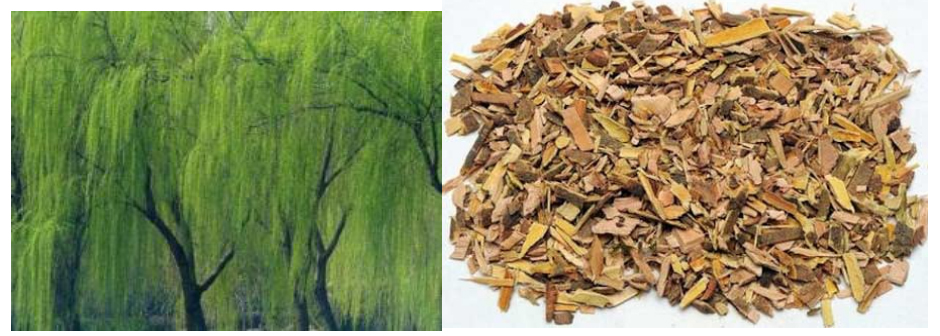
[Latin Name] Salix alba L.
[Plant Source] from China
[Specifications] Salicin 15-98%
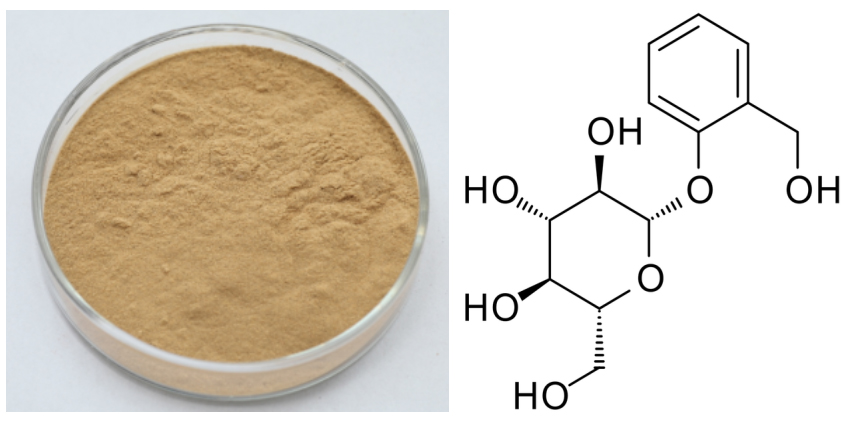
[Appearance] Yellow Brown to White powder
Plant Part Used: Bark
[Particle size] 80 Mesh
[Loss on drying] ≤5.0%
[Heavy Metal] ≤10PPM
[Storage] Store in cool & dry area, keep away from the direct light and heat.
[Shelf life] 24 Months
[Package] Packed in paper-drums and two plastic-bags inside.
[Net weight] 25kgs/drum
Brief Introduction
Salicin is a naturally occurring compound found in the bark of several species of trees, primarily North American in origin, that are from the willow, poplar, and aspen families. White willow, from whose Latin name, Salix alba, the term salicin is derived, is the most well known source of this compound, but it is found in a number of other trees, shrubs, and herbaceous plants as well being synthesized commercially. It is a member of the glucoside family of chemicals and is used as an analgesic and antipyretic. Salicin is used as a precursor for the synthesis of salicylic acid and acetylsalicylic acid, commonly known as aspirin.
A colorless, crystalline solid in its pure form, salicin has the chemical formula C13H18O7. Part of its chemical structure is equivalent to the sugar glucose, meaning it is classified as a glucoside. It is soluble, but not strongly so, in water and alcolhol. Salicin has a bitter taste and is a natural analgesic and antipyretic, or fever reducer. In large quantities, it can be toxic, and overdoses may lead to liver and kidney damage. In its raw form, it may be mildly irritating to skin, respiratory organs, and eyes.
Function
1. Salicin is used to ease pain and reduce inflammation.
2. Relieve acute and chronic pain, including headache, back and neck pain, muscle aches, and menstrual cramps; Control arthritis discomforts.
3. Relieve acute and chronic pain.
4. It has the same effect on the body as aspirin without any of the side effects.
5. It is an anti-inflammatory, a fever reducer, an analgesic, an anti-rheumatic, and an astringent. Specifically, it helps to relieve headaches.
Application
1.Anti-inflammatory, anti-rheumatic,
2.Reduce a fever,
3.Use as an analgesic and astringent,
4.Relieve headache,
5.Ease pain caused by rheumatism, arthritis, and carpal tunnel syndrome.
Product detail pictures:
Related Product Guide:
We aim to find out high quality disfigurement in the generation and provide the most effective services to domestic and abroad clients wholeheartedly for Renewable Design for White Willow Bark Extract Factory for Libya , The product will supply to all over the world, such as: Monaco, Jersey, Cairo, If any product meed your demand, please feel free to contact us. We're sure your any inquiry or requirement will get prompt attention, high-quality products, preferential prices and cheap freight. Sincerely welcome friends all over the world to call or come to visit, to discuss cooperation for a better future!
Garlic (Allium sativum)
What it’s good for: The pungent and popular bulb is particularly heart-friendly: In several studies, patients with atherosclerosis who took garlic signi-ficantly reduced the plaque in their arteries, says Mark Blumenthal, founder and executive director of the Austin, Texas-based American Botanical Council. “Garlic slightly lowers LDL, or bad cholesterol, and raises HDL, the good type,” he explains. “It also lowers blood pressure and reduces the potential for a stroke, because less plaque means there’s less possibility that pieces will break off from the artery walls and lodge in the brain or heart.”
Ginger (Zingiber officinale)
What it’s good for: As a natural anti- nausea remedy, this flavorful root has few equals. Most of the research shows it to be effective against morning sickness and post-chemotherapy nausea, and in several studies it fared even better than Dramamine in preventing motion sickness.
Oregano (Origanum vulgare)
What it’s good for: Studies show that oregano oil works to fight infections, thanks to two powerful compounds in the plant, thymol and carvacrol. “Oregano can be helpful for traveler’s diarrhea and giardiasisis,” says David Bunting, director of botanical and regulatory affairs at Herb Pharm in Williams, Oregon, “but it’s used primarily for upper respiratory infections. It’s best for short-term, low-grade problems like coughs and colds, but if you don’t feel better after several days, or you develop a high fever, you should definitely see a physician, who may need to prescribe antibiotics.”
Best form and dosage: Oregano essential oil, the most therapeutic form of oregano, is so powerful it can burn your mouth if taken inappropriately, says Glen Nagel, a naturopath and associate professor of botan- ical medicine at Bastyr University, in Seattle. So you’re better off with a product like Herb Pharm’s Oregano Spirits, which combines the essential oil with a liquid extract of oregano.
Sage (Salvia officinalis)
What it’s good for: Sage has long been thought of in traditional herbal medicine as a brain booster wisely, it turns out, since research is adding credibility to this age-old use. In a small British study of healthy adults, participants who took Spanish sage oil capsules consistently performed better on a word-recall test than those in a control group.
Best form and dosage: Alzheimer’s patients should take 30 drops of the liquid extract two to three times a day, Bunting says, as can a healthy person who’s just looking to stay sharp. For sore throats, try some sage tea or gargle with a very diluted solution of the liquid (10 to 20 drops) dissolved in a cup of warm water.
Caveats: In normal doses and in food, there’s no risk. But if you use it long term in amounts much higher than the recommended doses, it can bring on seizures.
Peppermint (Mentha x piperita)
What it’s good for: You’d be hard-pressed to find a better stomach-calming herb than peppermint (hence after-dinner mints). “It’s really good for any kind of digestive upset,” says Bunting. And peppermint oil, which comes in enteric-coated capsules, is one of the most effective natural treatments for irritable bowel syndrome (IBS).
Turmeric (Curcuma longa)
What it’s good for: This staple of Indian cooking is a powerful anti-inflammatory. Some studies suggests it works to ease the pain of osteoarthritis and rheumatoid arthritis. It may also help with other inflammatory conditions, such as tendinitis, and it may even protect your heart, given what we now know about the role of inflammation in heart disease.
This polysaccharide biochemistry lecture explains about the polysaccharide structure and synthesis for NET GATE exam.
https://www.shomusbiology.com/
Get Shomu’s Biology DVD set here-
https://www.shomusbiology.com/dvd-store/
Download the study materials here-
https://shomusbiology.com/bio-materials.html
Remember Shomu’s Biology is created to spread the knowledge of life science and biology by sharing all this free biology lectures video and animation presented by Suman Bhattacharjee in YouTube. All these tutorials are brought to you for free. Please subscribe to our channel so that we can grow together. You can check for any of the following services from Shomu’s Biology-
Buy Shomu’s Biology lecture DVD set- www.shomusbiology.com/dvd-store
Shomu’s Biology assignment services – www.shomusbiology.com/assignment -help
Join Online coaching for CSIR NET exam – www.shomusbiology.com/net-coaching
We are social. Find us on different sites here-
Our Website – www.shomusbiology.com
Facebook page- https://www.facebook.com/ShomusBiology/
Twitter – https://twitter.com/shomusbiology
SlideShare- www.slideshare.net/shomusbiology
Google plus- https://plus.google.com/113648584982732129198
LinkedIn – https://www.linkedin.com/in/suman-bhattacharjee-2a051661
Youtube- https://www.youtube.com/user/TheFunsuman
Thank you for watching
 By Alan from Ghana - 2018.02.21 12:14
We have been engaged in this industry for many years, we appreciate the work attitude and production capacity of the company, this is a reputable and professional manufacturer.
By Elaine from Rwanda - 2018.09.19 18:37