Wholesale Distributors for White Willow Bark Extract Supply to Lahore
Wholesale Distributors for White Willow Bark Extract Supply to Lahore Detail:
[Latin Name] Salix alba L.
[Plant Source] from China
[Specifications] Salicin 15-98%
[Appearance] Yellow Brown to White powder
Plant Part Used: Bark
[Particle size] 80 Mesh
[Loss on drying] ≤5.0%
[Heavy Metal] ≤10PPM
[Storage] Store in cool & dry area, keep away from the direct light and heat.
[Shelf life] 24 Months
[Package] Packed in paper-drums and two plastic-bags inside.
[Net weight] 25kgs/drum
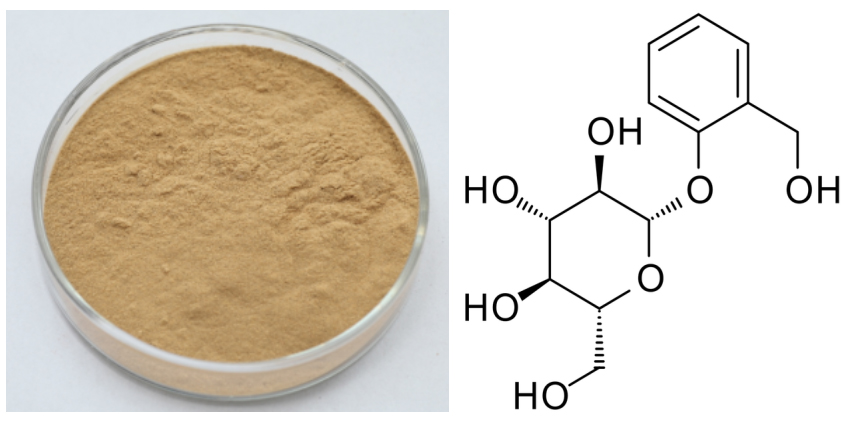
Brief Introduction
Salicin is a naturally occurring compound found in the bark of several species of trees, primarily North American in origin, that are from the willow, poplar, and aspen families. White willow, from whose Latin name, Salix alba, the term salicin is derived, is the most well known source of this compound, but it is found in a number of other trees, shrubs, and herbaceous plants as well being synthesized commercially. It is a member of the glucoside family of chemicals and is used as an analgesic and antipyretic. Salicin is used as a precursor for the synthesis of salicylic acid and acetylsalicylic acid, commonly known as aspirin.
A colorless, crystalline solid in its pure form, salicin has the chemical formula C13H18O7. Part of its chemical structure is equivalent to the sugar glucose, meaning it is classified as a glucoside. It is soluble, but not strongly so, in water and alcolhol. Salicin has a bitter taste and is a natural analgesic and antipyretic, or fever reducer. In large quantities, it can be toxic, and overdoses may lead to liver and kidney damage. In its raw form, it may be mildly irritating to skin, respiratory organs, and eyes.
Function
1. Salicin is used to ease pain and reduce inflammation.
2. Relieve acute and chronic pain, including headache, back and neck pain, muscle aches, and menstrual cramps; Control arthritis discomforts.
3. Relieve acute and chronic pain.
4. It has the same effect on the body as aspirin without any of the side effects.
5. It is an anti-inflammatory, a fever reducer, an analgesic, an anti-rheumatic, and an astringent. Specifically, it helps to relieve headaches.
Application
1.Anti-inflammatory, anti-rheumatic,
2.Reduce a fever,
3.Use as an analgesic and astringent,
4.Relieve headache,
5.Ease pain caused by rheumatism, arthritis, and carpal tunnel syndrome.
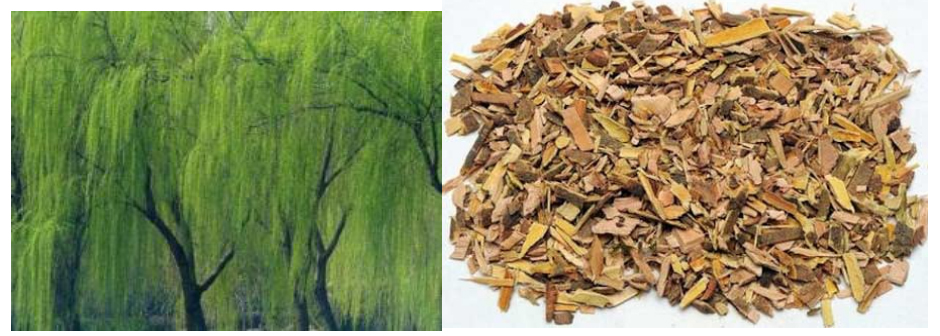
Product detail pictures:
Related Product Guide:
"Quality 1st, Honesty as base, Sincere company and mutual profit" is our idea, in an effort to create consistently and pursue the excellence for Wholesale Distributors for White Willow Bark Extract Supply to Lahore , The product will supply to all over the world, such as: Uganda, Kazakhstan, Japan, Our Company has professional engineers and technical staff to answer your questions about maintenance problems, some common failure. Our product quality assurance, price concessions, any questions about the products, Please feel free to contact us.
Visit https://jblossoms0113.blogspot.com/ for my review on Maqui Berry Benefits – How I Lost 83 Pounds.
About Me:
I’ve always been a big girl. I’ve tried exercising and diets in the past but none really worked. That is until I started taking Maqui Berry. I’ve lost 83 pounds and I feel amazing! No Special Diet, No Intense Exercise!
What is Maqui Berry?
1. It helps burn fat, even while you sleep
2. Maqui Berry helps fight against fatigue
3. It is a super, anti-oxidant which helps boost our immune system
I wish you all good luck with your weight loss!
maqui berry
maqui berry benefits
maqui berry reviews
maqui berries
maqui berry juice
buy maqui berry
maqui berry powder
maqui berry select
maqui superberry
benefits of maqui
beneifts of maqui berry
maqui berry health benefits
maqui berry diet
ultimate maqui berry review
maqui berry weight loss
Kalmegh
ANDROGRAPHIS PANICULATA WALL. EX. NEES. FAMILY – ACANTHACEAE
Kalmegh (Andrographis paniculata) is an important medicinal herb in India and it is widely used as hepatoprotective, immunomodulator, anti–inflammatory, anti–malarial, anti-diarrhoeal and with beneficial effect on respiratory and cardiovascular systems.
Kalmegh is a bitter annual (perennial, if maintained) herb, erect, 50 cm to 1m. in
height, stem quadrangular, much branched; leaves opposite, short petioled; flowers
in racemes. Fruit capsule linear, oblong or elliptic; seeds about 12 in number, subquadrate,
brownish or creamy yellow.
COMMON NAMES: Kirayat, Hara-chiretta, Kalpnath.
DISTRIBUTION:
It is widely distributed throughout plains of India from Uttar Pradesh to Assam,
Madhya Pradesh, Tamil Nadu and Kerala.
PART USED: Whole plant
CULTIVATION:
SOIL AND CLIMATE
It can be cultivated on wide range of soils from loam to lateritic soils with moderate
fertility. It can be cultivated on shady wastelands also.
The climatic requirement of the plant is hot and humid conditions with ample
sunshine. With the onset of monsoon, plant grows luxuriantly and starts flowering
with the moderation in temperature during September. Flowering and fruiting
continues upto December until temperature drops drastically in Northern plains.
NURSERY RAISING AND PLANTING
Its propagation is through shattered seeds in nature. Vegetative propagation is also
possible in certain special cases through layering as each node is capable of
producing enough roots. Seeds are small and remain dormant for five to six months.
For raising crop in one hectare three beds of 10×2 m size should be tilled, pulverized
and levelled during the month of May. Liberal use of manure in nursery is
advised for raising healthy seedling. Seeds should be covered by very thin layer of
soil and compost mixture. Beds should be covered properly by suitable mulch and
irrigated regularly with water fountain till seedlings merge (6-7 days).
Immediately after germination, mulch is removed to avoid elongation of the
seedlings. After 10-15 days regular flood irrigation can be given till it becomes ready
for planting.
Transplanting of seedling is done in second fortnight of June at a row and plant
spacing of 45 to 60 cm and 30 to 45 cm respectively. Beds should be irrigated
immediately after planting.
THINNING AND WEEDING
To begin with one or two weeding/hoeing are essential to get the crop established.
After establishment, crop grows well during monsoon and does not face any
competition from weed.
MANURES, FERTILISERS AND PESTICIDES
The medicinal plants have to be grown without chemical fertilizers and use of
pesticides. manures like, Farm Yard Manure (FYM), Vermi-Compost, Green
Manure etc. may be used as per requirement of the species. To prevent diseases,
bio-pesticides could be prepared (either single or mixture) from Neem (kernel, seeds
& leaves), Chitrakmool, Dhatura, Cow’s urine etc.
IRRIGATION
Fairly distributed rainfall during monsoon is sufficient to raise annual crop in
Northern states. But prior to rain 2-3 irrigations are required. Irrigation during
autumn does not show much effect on biomass yield as by that time plant is in
reproductive phase.
HARVESTING/POST HARVESTING OPERATION
Maximum herb biomass can be obtained in 90-100 days beyond which leaves start
shedding. If crop is raised as annual crop and planted during the month of May June,
it should be harvested by the end of the September when flowering is initiated. At
the time of flower initiation, active principle andrographolide is high in leaves. Since
the whole plant contains active principles, entire harvested material is dried in shade
and powdered.
YIELD
A well-maintained crop grown during monsoon season yields 3.5 to 4.0 tons of dried
herb per hectare.
Web: https://www.natureherbs.org | www.natureherbs.co
Email : natureherbs@ymail.com
Watsapp: +91 841 888 5555
Skype: nature.herbs
 By Mike from Hyderabad - 2017.01.11 17:15
In China, we have many partners, this company is the most satisfying to us, reliable quality and good credit, it is worth appreciation.
By Tyler Larson from Malawi - 2017.03.28 12:22