Wholesale Price Broccoli powder Factory in San Francisco
Wholesale Price Broccoli powder Factory in San Francisco Detail:
[Latin Name] Brassica oleracea L.var.italica L.
[Plant Source] from China
[Specifications]10:1
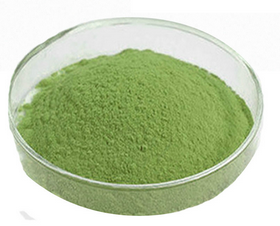
[Appearance] Light green to green powder
Plant Part Used: whole plant
[Particle size] 60 Mesh
[Loss on drying] ≤8.0%
[Heavy Metal] ≤10PPM
[Storage] Store in cool & dry area, keep away from the direct light and heat.
[Shelf life] 24 Months
[Package] Packed in paper-drums and two plastic-bags inside.
[Net weight] 25kgs/drum
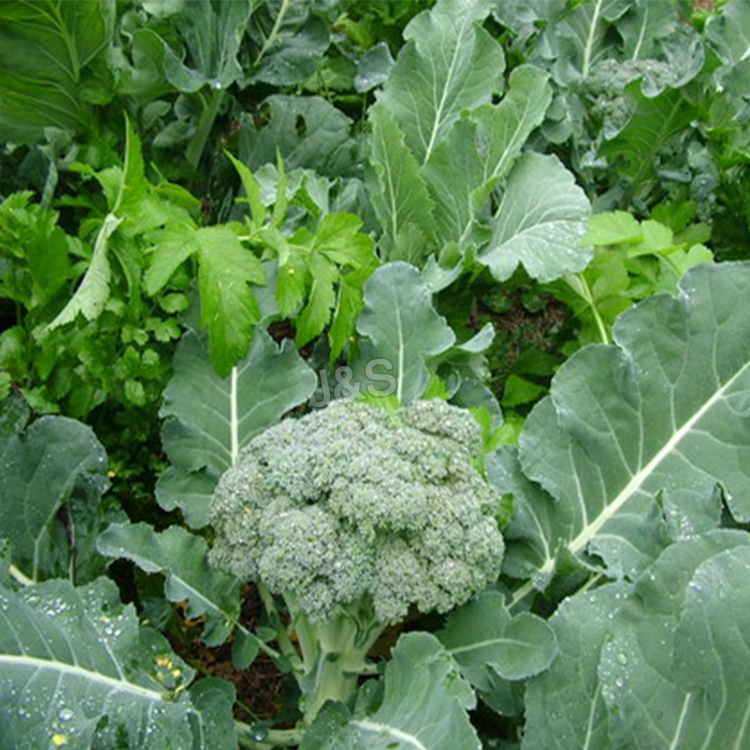
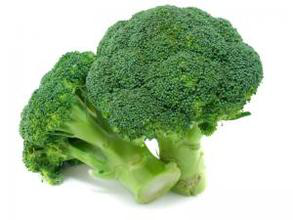
Broccoli is a member of the cabbage family, and is closely related to cauliflower. Its cultivation originated in Italy. Broccolo, its Italian name, means “cabbage sprout.” Because of its different components, broccoli provides a range of tastes and textures, from soft and flowery (the floret) to fibrous and crunchy (the stem and stalk). Broccoli contains glucosinolates, phytochemicals which break down to compounds called indoles and isothiocyanates (such as sulphoraphane). Broccoli also contains the carotenoid, lutein. Broccoli is an excellent source of the vitamins K, C, and A, as well as folate and fiber. Broccoli is a very good source of phosphorus, potassium, magnesium and the vitamins B6 and E.
Main Function
(1).With the function of anti-cancer, and effectively improving capability of blood scavenging;
(2).Having the great effect to prevent and regulate hypertension;
(3).With the function of enhancing liver detoxification, improve immunity;
(4).With the function of reducing blood sugar and cholesterol.
4. Application
(1).As drugs raw materials of anti-cancer, it is mainly used in pharmaceutical field;
(2).Applied in health product field, it can be used as raw material in health food, the purpose is to enhance immunity
(3).Applied in food fields, it is widely used as functional food additive.
Product detail pictures:
Related Product Guide:
It is our responsibility to meet your needs and efficiently serve you. Your satisfaction is our best reward. We are looking forward to your visit for joint growth for Wholesale Price Broccoli powder Factory in San Francisco , The product will supply to all over the world, such as: Argentina, Sacramento, Turin, We welcome you to visit our company, factory and our showroom displayed various products that will meet your expectation, meanwhile, it is convenient to visit our website, our sales staff will try their efforts to offer you the best service. If you need to have more information, remember to do not hesitate to contact us by E-mail or telephone.
Get Better Sex! https://bit.ly/ExtenZeEnhancement ExtenZe Male Enhancement is the proprietary blend of herbs and medical grade substances that can truly make a difference in your life. Being larger is not impossible and it doesn’t require surgery, prescriptions, gadgets or exercises. All it takes is taking a simple tablet. A tablet may seem too simple, but it’s not. Simple tablets have been making a difference in our lives for over half a century . . . from relieving pain, improving our health, managing our weight and increasing our energy. “Simple tablets” can be considered the mini-miracles of modern times.
What is BIOPOLYMER? What does BIOPOLYMERmean? BIOPOLYMER meaning – BIOPOLYMER pronunciation – BIOPOLYMER definition – BIOPOLYMER explanation – How to pronounce BIOPOLYMER?
Source: Wikipedia.org article, adapted under https://creativecommons.org/licenses/by-sa/3.0/ license.
Biopolymers are polymers produced by living organisms; in other words, they are polymeric biomolecules. Since they are polymers, biopolymers contain monomeric units that are covalently bonded to form larger structures. There are three main classes of biopolymers, classified according to the monomeric units used and the structure of the biopolymer formed: polynucleotides (RNA and DNA), which are long polymers composed of 13 or more nucleotide monomers; polypeptides, which are short polymers of amino acids; and polysaccharides, which are often linear bonded polymeric carbohydrate structures.
Cellulose is the most common compound and biopolymer on Earth. About 33 percent of all plant matter is cellulose. The cellulose content of cotton is 90 percent, for wood it is 50 percent.
A major defining difference between biopolymers and synthetic polymers can be found in their structures. All polymers are made of repetitive units called monomers. Biopolymers often have a well-defined structure, though this is not a defining characteristic (example: lignocellulose): The exact chemical composition and the sequence in which these units are arranged is called the primary structure, in the case of proteins. Many biopolymers spontaneously fold into characteristic compact shapes (see also “protein folding” as well as secondary structure and tertiary structure), which determine their biological functions and depend in a complicated way on their primary structures. Structural biology is the study of the structural properties of the biopolymers. In contrast, most synthetic polymers have much simpler and more random (or stochastic) structures. This fact leads to a molecular mass distribution that is missing in biopolymers. In fact, as their synthesis is controlled by a template-directed process in most in vivo systems, all biopolymers of a type (say one specific protein) are all alike: they all contain the similar sequences and numbers of monomers and thus all have the same mass. This phenomenon is called monodispersity in contrast to the polydispersity encountered in synthetic polymers. As a result, biopolymers have a polydispersity index of 1.
The convention for a polypeptide is to list its constituent amino acid residues as they occur from the amino terminus to the carboxylic acid terminus. The amino acid residues are always joined by peptide bonds. Protein, though used colloquially to refer to any polypeptide, refers to larger or fully functional forms and can consist of several polypeptide chains as well as single chains. Proteins can also be modified to include non-peptide components, such as saccharide chains and lipids.
The convention for a nucleic acid sequence is to list the nucleotides as they occur from the 5′ end to the 3′ end of the polymer chain, where 5′ and 3′ refer to the numbering of carbons around the ribose ring which participate in forming the phosphate diester linkages of the chain. Such a sequence is called the primary structure of the biopolymer.
Sugar-based biopolymers are often difficult with regards to convention. Sugar polymers can be linear or branched and are typically joined with glycosidic bonds. The exact placement of the linkage can vary, and the orientation of the linking functional groups is also important, resulting in ?- and ß-glycosidic bonds with numbering definitive of the linking carbons’ location in the ring. In addition, many saccharide units can undergo various chemical modifications, such as amination, and can even form parts of other molecules, such as glycoproteins.
 By Kay from Mumbai - 2017.09.09 10:18
The company can keep up with the changes in this industry market, product updates fast and the price is cheap, this is our second cooperation, it's good.
By Beulah from Mexico - 2017.05.02 11:33