11 Years Factory wholesale White Willow Bark Extract Factory from Luxembourg
11 Years Factory wholesale White Willow Bark Extract Factory from Luxembourg Detail:
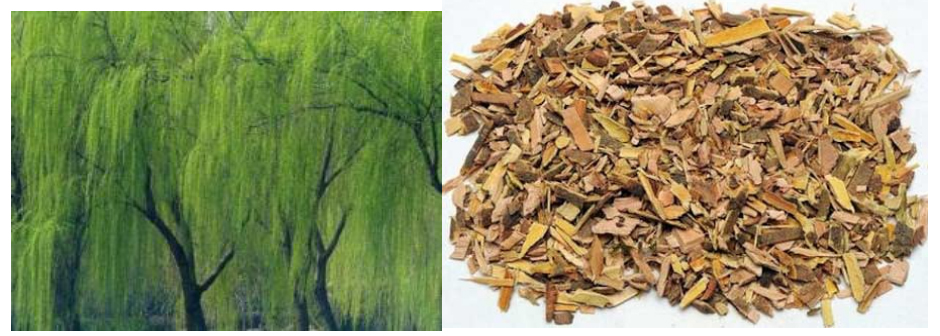
[Latin Name] Salix alba L.
[Plant Source] from China
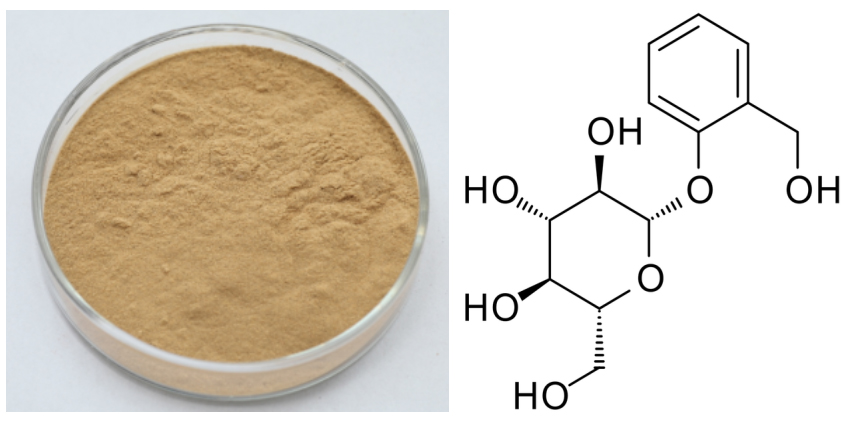
[Specifications] Salicin 15-98%
[Appearance] Yellow Brown to White powder
Plant Part Used: Bark
[Particle size] 80 Mesh
[Loss on drying] ≤5.0%
[Heavy Metal] ≤10PPM
[Storage] Store in cool & dry area, keep away from the direct light and heat.
[Shelf life] 24 Months
[Package] Packed in paper-drums and two plastic-bags inside.
[Net weight] 25kgs/drum
Brief Introduction
Salicin is a naturally occurring compound found in the bark of several species of trees, primarily North American in origin, that are from the willow, poplar, and aspen families. White willow, from whose Latin name, Salix alba, the term salicin is derived, is the most well known source of this compound, but it is found in a number of other trees, shrubs, and herbaceous plants as well being synthesized commercially. It is a member of the glucoside family of chemicals and is used as an analgesic and antipyretic. Salicin is used as a precursor for the synthesis of salicylic acid and acetylsalicylic acid, commonly known as aspirin.
A colorless, crystalline solid in its pure form, salicin has the chemical formula C13H18O7. Part of its chemical structure is equivalent to the sugar glucose, meaning it is classified as a glucoside. It is soluble, but not strongly so, in water and alcolhol. Salicin has a bitter taste and is a natural analgesic and antipyretic, or fever reducer. In large quantities, it can be toxic, and overdoses may lead to liver and kidney damage. In its raw form, it may be mildly irritating to skin, respiratory organs, and eyes.
Function
1. Salicin is used to ease pain and reduce inflammation.
2. Relieve acute and chronic pain, including headache, back and neck pain, muscle aches, and menstrual cramps; Control arthritis discomforts.
3. Relieve acute and chronic pain.
4. It has the same effect on the body as aspirin without any of the side effects.
5. It is an anti-inflammatory, a fever reducer, an analgesic, an anti-rheumatic, and an astringent. Specifically, it helps to relieve headaches.
Application
1.Anti-inflammatory, anti-rheumatic,
2.Reduce a fever,
3.Use as an analgesic and astringent,
4.Relieve headache,
5.Ease pain caused by rheumatism, arthritis, and carpal tunnel syndrome.
Product detail pictures:
Related Product Guide:
Our well-equipped facilities and great excellent command throughout all stages of generation enables us to guarantee total customer fulfillment for 11 Years Factory wholesale White Willow Bark Extract Factory from Luxembourg , The product will supply to all over the world, such as: Azerbaijan, Brisbane, Zambia, With many years good service and development, we've a professional international trade sales team. Our products have exported to North America, Europe, Japan, Korea, Australia, New Zealand, Russia and other countries. Looking forward to build up a good and long term cooperation with you in coming future!
Cellulose is a homopolysaccharide of glucose found in plants. It has beta 1-4 glycosidic bonds.
Get your FREE Atomy account: https://atomymasters.com/join
For a video demonstration on the Atomy Evening Care 4 Set see: https://www.youtube.com/watch?v=fQRD32ErPTs
Atomy Skin Care 6-System Day set (You can also use in the evening too except for the BB cream which is morning only.)
1. Toner [135ml]: Trouble care
Cares for various skin type using biotechnology contains fresh herb tea.
Directions: Take appropriate amount and apply on the face morning and evening.
2. Lotion [135ml]: Moisturizing care
Black yeast beta-glucan, a moisturizing factor using fermentation life science, attracts moisture in the air to continuously moisturize the skin.
Directions: Take appropriate amount and apply on the face morning and evening.
3. Essence [50ml]: Nutrition care
Phellinus linteus rice generated by culturing and fermenting Phellinus linteus mycelia on brown rice is made into 100% nano particles and penetrates deep into skin.
Directions: Take appropriate amount and apply on the face morning and evening.
4. Nutrition Cream [50ml]: Aging care
Phellinus linteus Paecilomyces japonica of Korean medicine fermentation science generated by fermenting Paecilomyces japonica on natural Phellinus linteus and Phellinus linteus rice. Poly-saccharine, which is a skin protection ingredient of Phellinus linteus, and rich amino acids of vegetable worms helps maintain skin elasticity.
Directions: Take appropriate amount and apply on the face morning and evening.
5. Eye Cream [33ml]: Wrinkle improvement
A wrinkle improvement functional Adenosine substance approved by K-FDA, plays a vital role on energy metabolism of the skin. This is a functional cosmetic product.
Directions: Take appropriate amount and apply around the eye area morning and evening.
6. BB Cream [40ml]: Broad Spectrum SPF30
It is a double functional product for whitening and UV screening functions.
Protects the skin from harmful external elements and keeps the skin clean and clear.
Directions: Take appropriate amount and apply on the face in the morning especially on dark spots, discoloration & pigmentation.
Atomy Skin Care 6-System main ingredients:
(a) Fresh Herb Tea – herb tea cares for various skin troubles to maintain healthy skin.
(b) 7 Fresh Herbs; rosemary, Houttuynia cordata (also known as Chameleon plant) lavender, chamomile, fennel seed, basil, marshmallow.
(c) Black Yeast Beta-glucan – Black yeast beta-glucan maintains healthy skin, to safeguard against harmful factors through skin moisturization reinforcement.
(d) Phellinus linteus Paecilomyces Japonica – An energy source for skin vitality using Korean Medicine Aging Biotechnology & Herbal Life Science Technology, assist with skin health and elasticity making skin beautiful.
(e) Diospyros kaki leaf extracts – Contains vitamin C, tannin, vitamin & flavonoid, bio-active substance.
The complete 6 set is only $92 USD. You can also buy each product in the set individually for only $17 each. Membership is FREE and there are no monthly purchase requirements or auto ship like other companies! For more info and to join to purchase see: https://atomymasters.com/ and then order your products directly from Atomy at: https://www.atomy.com/us
 By Irene from Bogota - 2018.07.27 12:26
This supplier offers high quality but low price products, it is really a nice manufacturer and business partner.
By Mildred from Sacramento - 2018.02.12 14:52